Books
Our own original workbooks and e-books, plus books we recommend for going deeper on a topic.
Anxiety
View all →Understand anxious thinking and build practical calm.
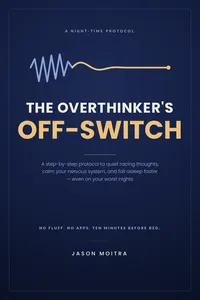
The Overthinker's Off-Switch
Jason Moitra
A step-by-step, no-fluff protocol for quieting a racing mind at night — built around the idea that there are only three kinds of 2am thoughts, and each one needs a different response. Includes a 10-minute wind-down routine, a plan for the moment you wake up already spiraling, and a 30-day path to a calmer nightly routine.
Who it's for
Anyone who regularly lies awake overthinking — replaying conversations, worrying about tomorrow, or unable to switch their brain off at night. It's a practical tool, not a replacement for therapy — and it says so honestly if what you're dealing with needs more support than a book can offer.
It Didn't Start With You
Mark Wolynn
This book explores a genuinely fascinating and still-developing area of trauma research: how trauma and its effects can be passed down across generations, shaping anxieties and patterns whose true origin isn't in your own life story at all. For readers who feel like a fear or pattern doesn't quite make sense given their own history, this offers a compelling explanation.
Who it's for
Readers who sense that a persistent fear, anxiety, or pattern doesn't fully make sense given their own life experience, and want to explore possible family or generational roots.
The Relaxation and Stress Reduction Workbook
Martha Davis, Elizabeth Robbins Eshelman & Matthew McKay
In print for decades and updated across multiple editions, this is less a book you read once and more a reference toolkit you return to — covering nearly every evidence-based relaxation technique in one place, from progressive muscle relaxation to biofeedback to time management. If you want breadth and a technique for every situation, this covers the most ground.
Who it's for
Readers who want a comprehensive reference of relaxation and stress-management techniques to draw from, rather than committing to just one method.
Overcoming Unwanted Intrusive Thoughts
Sally M. Winston, PsyD & Martin N. Seif, PhD
For the specific, often distressing experience of intrusive, unwanted thoughts that loop uninvited, this book by two anxiety specialists offers real clarity and relief — explaining why everyone has strange intrusive thoughts, and why trying to push them away is exactly what keeps them coming back.
Who it's for
Readers dealing specifically with distressing, unwanted intrusive thoughts (not just general worry), who want to understand why the harder they try to stop them, the more they persist.
The Worry Trick
David Carbonell, PhD
Written by a psychologist who specializes in anxiety, this book explains worry as a trick your brain plays on itself — convincing you that more worrying equals more safety, when it actually just prolongs distress. It's especially good at explaining why trying to reason your way out of worry often backfires, and what to do instead.
Who it's for
Readers who intellectually know their worry is excessive but can't seem to reason their way out of it, and want to understand why logic alone doesn't work.
Stop Overthinking
Nick Trenton
A short, focused, no-filler book that goes straight at the mechanics of chronic overthinking — why your brain loops, and specific techniques to interrupt it. If you want something you can read in a weekend and start applying immediately, this is one of the more approachable, action-oriented options in this category.
Who it's for
Readers who want a short, practical, jargon-light introduction to overthinking specifically, without a long theoretical build-up.
The Anxiety and Worry Workbook
David A. Clark & Aaron T. Beck
Co-written by the founder of cognitive therapy himself, this workbook applies the core CBT model specifically to anxiety and chronic worry, with the exercises and rigor of a clinical program. If Feeling Great or Mind Over Mood felt broad, this is the more anxiety-specific companion, built on the same foundational research.
Who it's for
Readers whose primary struggle is anxiety and worry specifically (rather than depression), who want a CBT workbook built specifically around that presentation.
Retrain Your Brain: Cognitive Behavioral Therapy in 7 Weeks
Seth J. Gillihan, PhD
For readers who want structure and a defined finish line, this book compresses core CBT skills into a specific seven-week program with a clear weekly focus. It's less overwhelming than a comprehensive workbook and more like a guided course you can actually complete, making it a great entry point if the idea of an open-ended self-help book feels daunting.
Who it's for
Readers who do best with a structured, time-bound program rather than an open-ended workbook, and want to feel a sense of completion.
Mind Over Mood
Dennis Greenberger & Christine A. Padesky
Used by therapists as an actual course of treatment, not just recommended reading, Mind Over Mood is one of the most clinically respected CBT workbooks in print. Its structured, worksheet-driven approach means you're not just reading about cognitive therapy — you're actually doing it, step by step, the same way a therapist would guide you through it in session.
Who it's for
Readers who want a genuinely clinical-grade CBT workbook — the kind therapists assign as homework — for depression, anxiety, or a mix of both.
Unwinding Anxiety
Dr. Judson Brewer
Written by a psychiatrist and neuroscientist who studies habit loops, this book treats anxiety as something that can be examined and "unwound" the same way any other unhelpful habit can — through curiosity about the anxious pattern rather than a battle against it. It's a more mindfulness-oriented alternative for readers who've found conventional CBT-only approaches too rigid.
Who it's for
Readers who are drawn to mindfulness-based approaches and want to understand anxiety as a habit loop they can work with, rather than a threat to eliminate.
Rewire Your Anxious Brain
Catherine M. Pittman & Elizabeth M. Karle
If you're the kind of reader who wants to understand the actual neuroscience behind why a technique works before trusting it, this is the anxiety book written for you. It explains the amygdala and cortex pathways involved in anxiety in accessible terms, then matches specific techniques to which brain pathway is driving your particular anxiety.
Who it's for
Readers who want a neuroscience-grounded explanation of anxiety, and who respond better to understanding the "why" behind a technique before trying it.
Hope and Help for Your Nerves
Dr. Claire Weekes
First published decades ago and still recommended today, this book introduced the concept of "floating through" anxiety instead of fighting it — an idea that predates and quietly underlies much of modern anxiety treatment. Its plain, compassionate language has helped generations of readers stop being afraid of their own symptoms.
Who it's for
Readers who want a warm, reassuring explanation of nervous system symptoms — palpitations, trembling, derealization — from a doctor who treated anxiety long before it was widely understood.
The Anxiety and Phobia Workbook
Edmund J. Bourne
This is the book therapists themselves recommend most often for anxiety — a comprehensive, practical workbook rather than a memoir or theory-heavy read. If you want one thorough resource that covers relaxation techniques, cognitive restructuring, exposure therapy, and lifestyle factors all in one place, this is the closest thing to a complete anxiety toolkit in a single volume.
Who it's for
Readers who want a structured, workbook-style resource covering the full range of anxiety — generalized anxiety, panic, phobias, and social anxiety — rather than a book focused on just one presentation.
DARE: The New Way to End Anxiety and Stop Panic Attacks
Barry McDonagh
Most anxiety advice tells you to calm down, which rarely works in the middle of a panic spike. DARE takes the opposite approach — leaning into the sensations instead of fighting them — and it's become one of the most talked-about anxiety books precisely because it addresses the moment of panic itself, not just the calm periods in between.
Who it's for
Anyone who experiences panic attacks or acute anxiety spikes and has already tried "just relax" advice that didn't hold up in the moment it actually mattered.
Feeling Great
Dr. David D. Burns
A modern follow-up to the classic 'Feeling Good', presenting Dr. Burns's TEAM-CBT method for rapidly identifying and reframing the cognitive distortions that drive depression and anxiety.
Who it's for
Anyone experiencing persistent low mood, self-criticism, or anxiety who wants a structured, workbook-style approach grounded in cognitive behavioral therapy.
CBT
View all →Cognitive behavioral techniques you can use today.
Declutter Your Mind
S.J. Scott & Barrie Davenport
This book treats mental clutter the same way productivity books treat physical clutter — as something you can systematically identify and clear out. It combines CBT-style techniques with mindfulness and habit-building, giving readers a genuinely varied toolkit rather than a single-technique approach to quieting a busy mind.
Who it's for
Readers who like the idea of "decluttering" as a framework, and want a varied toolkit spanning CBT, mindfulness, and habit change rather than one single method.
Self-Esteem: A Proven Program of Cognitive Techniques
Matthew McKay & Patrick Fanning
This workbook applies CBT specifically to the inner critic and harsh self-judgment, giving you the same structured, exercise-driven approach used for anxiety and depression but aimed squarely at how you talk to yourself. It's a practical complement to more theory-driven self-esteem books, focused on actually changing the pattern rather than just understanding it.
Who it's for
Readers whose low self-esteem shows up mainly as harsh self-criticism and negative self-talk, who want a structured, CBT-based way to work on it directly.
The Anxiety and Worry Workbook
David A. Clark & Aaron T. Beck
Co-written by the founder of cognitive therapy himself, this workbook applies the core CBT model specifically to anxiety and chronic worry, with the exercises and rigor of a clinical program. If Feeling Great or Mind Over Mood felt broad, this is the more anxiety-specific companion, built on the same foundational research.
Who it's for
Readers whose primary struggle is anxiety and worry specifically (rather than depression), who want a CBT workbook built specifically around that presentation.
Cognitive Therapy of Depression
Aaron T. Beck, A. John Rush, Brian F. Shaw & Gary Emery
Written by the psychiatrist who founded cognitive therapy itself, this is the original clinical text that everything else in the CBT space ultimately builds on. It's more academic than the average self-help book, but for readers who want to go straight to the source and understand CBT's actual theoretical foundations, there's no more authoritative option.
Who it's for
Readers who want to understand CBT at its clinical, foundational level — including students, clinicians-in-training, or self-help readers who've outgrown pop-psychology explanations and want the real depth.
Retrain Your Brain: Cognitive Behavioral Therapy in 7 Weeks
Seth J. Gillihan, PhD
For readers who want structure and a defined finish line, this book compresses core CBT skills into a specific seven-week program with a clear weekly focus. It's less overwhelming than a comprehensive workbook and more like a guided course you can actually complete, making it a great entry point if the idea of an open-ended self-help book feels daunting.
Who it's for
Readers who do best with a structured, time-bound program rather than an open-ended workbook, and want to feel a sense of completion.
Mind Over Mood
Dennis Greenberger & Christine A. Padesky
Used by therapists as an actual course of treatment, not just recommended reading, Mind Over Mood is one of the most clinically respected CBT workbooks in print. Its structured, worksheet-driven approach means you're not just reading about cognitive therapy — you're actually doing it, step by step, the same way a therapist would guide you through it in session.
Who it's for
Readers who want a genuinely clinical-grade CBT workbook — the kind therapists assign as homework — for depression, anxiety, or a mix of both.
The Anxiety and Phobia Workbook
Edmund J. Bourne
This is the book therapists themselves recommend most often for anxiety — a comprehensive, practical workbook rather than a memoir or theory-heavy read. If you want one thorough resource that covers relaxation techniques, cognitive restructuring, exposure therapy, and lifestyle factors all in one place, this is the closest thing to a complete anxiety toolkit in a single volume.
Who it's for
Readers who want a structured, workbook-style resource covering the full range of anxiety — generalized anxiety, panic, phobias, and social anxiety — rather than a book focused on just one presentation.
Feeling Good: The New Mood Therapy
Dr. David D. Burns
Millions of copies sold and still recommended by therapists today, Feeling Good is the original, foundational book that brought cognitive therapy for depression to a general audience. If you want to understand exactly how your thoughts generate your mood — and get a genuinely practical toolkit for changing that — this is the classic starting point.
Who it's for
Anyone experiencing depression or persistent low mood who wants a clear, structured, and thoroughly evidence-based introduction to cognitive therapy.
Feeling Great
Dr. David D. Burns
A modern follow-up to the classic 'Feeling Good', presenting Dr. Burns's TEAM-CBT method for rapidly identifying and reframing the cognitive distortions that drive depression and anxiety.
Who it's for
Anyone experiencing persistent low mood, self-criticism, or anxiety who wants a structured, workbook-style approach grounded in cognitive behavioral therapy.
Depression
View all →Evidence-based tools for low mood and motivation.
The Mindful Way Through Depression
Mark Williams, John Teasdale, Zindel Segal & Jon Kabat-Zinn
Written by the researchers who developed Mindfulness-Based Cognitive Therapy (MBCT) — a clinically validated treatment specifically for preventing depression relapse — this book brings that structured program directly to readers, with an accompanying guided meditation component. It's the most clinically targeted mindfulness book for depression specifically, rather than mindfulness in general.
Who it's for
Readers who've experienced depression before and want a specific, research-validated approach to preventing relapse, rather than general mindfulness content.
Cognitive Therapy of Depression
Aaron T. Beck, A. John Rush, Brian F. Shaw & Gary Emery
Written by the psychiatrist who founded cognitive therapy itself, this is the original clinical text that everything else in the CBT space ultimately builds on. It's more academic than the average self-help book, but for readers who want to go straight to the source and understand CBT's actual theoretical foundations, there's no more authoritative option.
Who it's for
Readers who want to understand CBT at its clinical, foundational level — including students, clinicians-in-training, or self-help readers who've outgrown pop-psychology explanations and want the real depth.
Retrain Your Brain: Cognitive Behavioral Therapy in 7 Weeks
Seth J. Gillihan, PhD
For readers who want structure and a defined finish line, this book compresses core CBT skills into a specific seven-week program with a clear weekly focus. It's less overwhelming than a comprehensive workbook and more like a guided course you can actually complete, making it a great entry point if the idea of an open-ended self-help book feels daunting.
Who it's for
Readers who do best with a structured, time-bound program rather than an open-ended workbook, and want to feel a sense of completion.
Mind Over Mood
Dennis Greenberger & Christine A. Padesky
Used by therapists as an actual course of treatment, not just recommended reading, Mind Over Mood is one of the most clinically respected CBT workbooks in print. Its structured, worksheet-driven approach means you're not just reading about cognitive therapy — you're actually doing it, step by step, the same way a therapist would guide you through it in session.
Who it's for
Readers who want a genuinely clinical-grade CBT workbook — the kind therapists assign as homework — for depression, anxiety, or a mix of both.
The Noonday Demon: An Atlas of Depression
Andrew Solomon
Part memoir, part sweeping cultural and scientific history of depression, this Pulitzer Prize–nominated, National Book Award–winning book is less a self-help manual and more a deeply humane exploration of what depression actually is — across cultures, treatments, and eras. For readers who want to feel truly understood, and to understand depression as a whole phenomenon rather than a checklist of symptoms, it's an essential, moving read.
Who it's for
Readers who want depth and validation as much as technique — a book that captures the full lived experience of depression, not just its clinical treatment.
Undoing Depression
Richard O'Connor, PhD
This book's central, often-quoted insight is that depression isn't just a mood — it's a set of learned habits of thinking, relating, and coping that persist even after the mood lifts, which is why relapse is so common. It's a clear-eyed, practical guide to unlearning those habits, written by a therapist who has also lived with depression himself.
Who it's for
Readers who've noticed that even during better periods, old depressive habits of thinking and relating tend to creep back in, and want to understand why.
The Upward Spiral
Alex Korb, PhD
Written by a neuroscientist, this book explains depression as a downward spiral of interconnected brain processes — and, more usefully, shows exactly how small, specific actions can reverse that spiral one step at a time. If you want the biology explained clearly alongside genuinely small, doable actions, this is one of the most approachable neuroscience-based depression books available.
Who it's for
Readers who want to understand the brain science behind depression without a textbook feel, paired with realistically small daily actions rather than a demanding overhaul.
Lost Connections
Johann Hari
Part investigative journalism, part personal story, this book asks a question most depression books skip: what if depression is often less about a chemical imbalance and more about disconnection — from meaningful work, other people, and a sense of a secure future? It's a compelling, well-researched read for anyone who wants to understand the social and environmental causes of depression, not just the biological ones.
Who it's for
Readers who feel like purely biological or purely cognitive explanations of depression are missing something, and want a broader look at the social and environmental causes.
Feeling Good: The New Mood Therapy
Dr. David D. Burns
Millions of copies sold and still recommended by therapists today, Feeling Good is the original, foundational book that brought cognitive therapy for depression to a general audience. If you want to understand exactly how your thoughts generate your mood — and get a genuinely practical toolkit for changing that — this is the classic starting point.
Who it's for
Anyone experiencing depression or persistent low mood who wants a clear, structured, and thoroughly evidence-based introduction to cognitive therapy.
Feeling Great
Dr. David D. Burns
A modern follow-up to the classic 'Feeling Good', presenting Dr. Burns's TEAM-CBT method for rapidly identifying and reframing the cognitive distortions that drive depression and anxiety.
Who it's for
Anyone experiencing persistent low mood, self-criticism, or anxiety who wants a structured, workbook-style approach grounded in cognitive behavioral therapy.
Emotional Regulation
View all →Understand and work with intense emotions skillfully.
Calming the Emotional Storm
Sheri Van Dijk, MSW
A more approachable, self-help-oriented adaptation of Dialectical Behavior Therapy (DBT) than clinical workbooks, this book is specifically aimed at readers who experience emotions as sudden, intense "storms" that feel difficult to see coming or manage once they start. It bridges clinical rigor and everyday readability especially well.
Who it's for
Readers whose emotional intensity feels sudden and overwhelming — like a storm arriving with little warning — who want DBT-based skills without a dense clinical workbook format.
The Language of Emotions
Karla McLaren, MEd
This book treats every emotion — including the ones we typically label "negative," like anger, jealousy, and shame — as carrying specific, useful information, rather than being problems to eliminate. For readers who've been taught that certain emotions are simply bad and should be suppressed, this offers a genuinely different, more workable relationship to the full range of what you feel.
Who it's for
Readers who've internalized the idea that certain emotions (anger, jealousy, shame) are simply bad, and want to understand the useful information each emotion is actually signaling.
Emotional Agility
Susan David, PhD
Psychologist Susan David challenges both the "suppress your emotions" and "always express your emotions" camps, arguing for something more nuanced: the ability to hold difficult emotions with curiosity rather than either fighting them or being ruled by them. It's a research-backed, practically actionable middle path for readers tired of extremes.
Who it's for
Readers who've noticed that both suppressing emotions and venting them fully tend to backfire, and want a more nuanced, workable middle approach.
The Dialectical Behavior Therapy Skills Workbook
Matthew McKay, Jeffrey C. Wood & Jeffrey Brantley
Dialectical Behavior Therapy (DBT) was originally developed for intense emotional dysregulation and remains one of the most effective, research-backed approaches available for it. This workbook adapts the full clinical DBT skill set — distress tolerance, emotion regulation, mindfulness, and interpersonal effectiveness — for self-guided use.
Who it's for
Readers experiencing intense, hard-to-manage emotions or frequent emotional overwhelm, who want the full clinical DBT skill set in a self-guided workbook format.
Permission to Feel
Marc Brackett, PhD
Founder of the Yale Center for Emotional Intelligence, Marc Brackett argues that most of us were never actually taught how to identify or work with our emotions — we were taught to suppress or perform them instead. This book gives you the vocabulary and framework (RULER) that's now used in schools worldwide, adapted for adult readers who never got that education.
Who it's for
Readers who struggle to identify or articulate what they're actually feeling, and want a structured framework for building genuine emotional literacy.
Complex PTSD: From Surviving to Thriving
Pete Walker
Written specifically for the effects of prolonged, repeated trauma (like childhood emotional neglect or abuse) rather than a single traumatic event, this book gives a name and framework to a set of experiences — like the "emotional flashback" — that often go unrecognized and unaddressed by more general trauma resources.
Who it's for
Readers whose trauma stems from prolonged or repeated experiences, particularly childhood emotional neglect or abuse, rather than a single traumatic incident — best read alongside professional support.
The Body Keeps the Score
Bessel van der Kolk, MD
One of the most influential books on trauma ever published, this book makes the case — now widely supported by neuroscience — that trauma isn't just a psychological memory, it's stored in the body itself, which is why talk therapy alone sometimes isn't enough. It's essential reading for understanding why trauma affects sleep, relationships, and physical health, not just mood.
Who it's for
Readers who've experienced trauma and want to understand why it affects the body and nervous system so directly, not just thoughts and memories — best read alongside professional support.
When the Body Says No
Dr. Gabor Maté
Physician Gabor Maté makes a compelling, well-documented case that chronic stress — particularly the kind that comes from suppressing emotions to keep the peace — has measurable links to physical illness. It's a thought-provoking read for anyone who senses a connection between their stress and their physical health but hasn't seen it laid out with this much clinical grounding.
Who it's for
Readers who suspect a connection between chronic stress or suppressed emotion and their physical health, and want that link explored with real clinical and research depth.
Burnout: The Secret to Unlocking the Stress Cycle
Emily Nagoski, PhD & Amelia Nagoski, DMA
This book makes a crucial distinction most stress advice misses: dealing with the *stressor* (the problem itself) is different from completing the *stress cycle* in your body, and you can solve the first without ever doing the second — leaving you stressed even after the problem is gone. If you've fixed the problem but still feel wired and exhausted, this book explains why.
Who it's for
Readers — especially those juggling caregiving, high-pressure work, or constant demands — who feel chronically depleted even when things are, on paper, going fine.
Nonviolent Communication
Marshall B. Rosenberg, PhD
This book gives you an actual language structure for difficult conversations — separating observations from judgments, and needs from demands — that dramatically reduces the defensiveness most disagreements trigger. It's used far beyond romantic relationships, in workplaces and conflict mediation, because the core skill genuinely transfers anywhere communication breaks down.
Who it's for
Readers whose difficult conversations tend to escalate into defensiveness or conflict, who want a concrete communication framework rather than general advice to "communicate better."
Habits
View all →The behavioral science of change that actually sticks.
Mindset: The New Psychology of Success
Carol S. Dweck, PhD
Stanford psychologist Carol Dweck's research on "fixed" versus "growth" mindsets has become one of the most influential ideas in modern personal development — the belief that abilities are either fixed traits or capacities that can be developed shapes everything from how you handle failure to whether you take on new challenges at all.
Who it's for
Readers who avoid challenges for fear of failure or feel that their abilities are essentially fixed, and want research-backed tools for building a more growth-oriented outlook.
The One Thing
Gary Keller & Jay Papasan
Built around a single, deceptively simple question — "what's the one thing I can do such that by doing it, everything else becomes easier or unnecessary?" — this book offers a clarifying filter for anyone drowning in competing priorities and to-do list overwhelm.
Who it's for
Readers whose to-do lists have become unmanageable, who want one clarifying question to cut through competing priorities rather than another complex system.
Deep Work
Cal Newport
Computer science professor Cal Newport makes a compelling case that the ability to focus without distraction is becoming both increasingly rare and increasingly valuable — and that most knowledge workers have let shallow, reactive work crowd out the deep focus that actually produces meaningful results. This is less about time-management tricks and more about protecting your capacity to focus at all.
Who it's for
Knowledge workers whose days are consumed by email, meetings, and notifications, who suspect they're busy but not actually producing their best work.
The 7 Habits of Highly Effective People
Stephen R. Covey
A modern classic that has sold tens of millions of copies, this book takes a broader, values-based approach to habits than most — arguing that lasting effectiveness comes from character and principles, not quick technique fixes. It remains one of the most widely referenced personal-development books in existence for a reason.
Who it's for
Readers who want a foundational, principles-based framework for personal effectiveness that goes beyond any single habit or technique.
Good Habits, Bad Habits
Wendy Wood, PhD
Written by one of the leading academic researchers on habit formation, this book cuts through popular habit advice with what the actual peer-reviewed research shows — including some genuinely counterintuitive findings, like how much more context and environment matter compared to willpower. If you want the science without the oversimplification, this is the most rigorously research-backed option.
Who it's for
Readers who want habit-formation advice grounded strictly in academic research, including a critical look at popular claims (like the "21 days to form a habit" myth).
Tiny Habits
BJ Fogg, PhD
Stanford behavior scientist BJ Fogg makes the case that the reason most habits fail isn't lack of motivation — it's that people start too big. His method focuses on habits so small they're almost impossible to fail at, anchored to existing routines, which makes this an especially good fit for anyone who's tried and abandoned more ambitious habit plans before.
Who it's for
Readers who've repeatedly tried and failed to build habits through willpower or motivation, and want a method built around starting deliberately small instead.
The Power of Habit
Charles Duhigg
Through a mix of business case studies, neuroscience, and personal stories, this book explains the "habit loop" — cue, routine, reward — that underlies every habit you have, and shows how identifying that loop is the key to actually changing it. It's a more narrative, story-driven read than a straight how-to guide, ideal if you like understanding the science before applying it.
Who it's for
Readers who enjoy narrative, story-driven nonfiction and want to deeply understand the psychology of habits before applying techniques.
Atomic Habits
James Clear
The single best-selling habits book of the last decade, and for good reason — it distills the behavioral science of habit formation into an unusually clear, actionable system built around tiny, 1% improvements. If you only read one book about building better habits, this is the one most consistently recommended by readers and experts alike.
Who it's for
Anyone trying to build a new habit or break an old one, who wants a clear, systematic framework rather than scattered tips.
Declutter Your Mind
S.J. Scott & Barrie Davenport
This book treats mental clutter the same way productivity books treat physical clutter — as something you can systematically identify and clear out. It combines CBT-style techniques with mindfulness and habit-building, giving readers a genuinely varied toolkit rather than a single-technique approach to quieting a busy mind.
Who it's for
Readers who like the idea of "decluttering" as a framework, and want a varied toolkit spanning CBT, mindfulness, and habit change rather than one single method.
Undoing Depression
Richard O'Connor, PhD
This book's central, often-quoted insight is that depression isn't just a mood — it's a set of learned habits of thinking, relating, and coping that persist even after the mood lifts, which is why relapse is so common. It's a clear-eyed, practical guide to unlearning those habits, written by a therapist who has also lived with depression himself.
Who it's for
Readers who've noticed that even during better periods, old depressive habits of thinking and relating tend to creep back in, and want to understand why.
The Upward Spiral
Alex Korb, PhD
Written by a neuroscientist, this book explains depression as a downward spiral of interconnected brain processes — and, more usefully, shows exactly how small, specific actions can reverse that spiral one step at a time. If you want the biology explained clearly alongside genuinely small, doable actions, this is one of the most approachable neuroscience-based depression books available.
Who it's for
Readers who want to understand the brain science behind depression without a textbook feel, paired with realistically small daily actions rather than a demanding overhaul.
Mindfulness
View all →Present-moment awareness, backed by research.
The Untethered Soul
Michael A. Singer
This book asks a genuinely disorienting but useful question: who is the "you" that's aware of your thoughts and feelings, separate from the thoughts and feelings themselves? Blending psychology, mindfulness, and spirituality, it's aimed at readers who want to examine their relationship to their own inner experience at a fairly deep level.
Who it's for
Readers drawn to a more introspective, consciousness-oriented approach to personal growth, comfortable blending psychological and spiritual perspectives.
The Dialectical Behavior Therapy Skills Workbook
Matthew McKay, Jeffrey C. Wood & Jeffrey Brantley
Dialectical Behavior Therapy (DBT) was originally developed for intense emotional dysregulation and remains one of the most effective, research-backed approaches available for it. This workbook adapts the full clinical DBT skill set — distress tolerance, emotion regulation, mindfulness, and interpersonal effectiveness — for self-guided use.
Who it's for
Readers experiencing intense, hard-to-manage emotions or frequent emotional overwhelm, who want the full clinical DBT skill set in a self-guided workbook format.
The Mindful Way Through Depression
Mark Williams, John Teasdale, Zindel Segal & Jon Kabat-Zinn
Written by the researchers who developed Mindfulness-Based Cognitive Therapy (MBCT) — a clinically validated treatment specifically for preventing depression relapse — this book brings that structured program directly to readers, with an accompanying guided meditation component. It's the most clinically targeted mindfulness book for depression specifically, rather than mindfulness in general.
Who it's for
Readers who've experienced depression before and want a specific, research-validated approach to preventing relapse, rather than general mindfulness content.
Radical Acceptance
Tara Brach, PhD
Psychologist and meditation teacher Tara Brach blends mindfulness practice with a compassion-focused lens, addressing the deep sense of unworthiness that often underlies both anxiety and self-criticism. It's a good fit for readers whose struggle isn't just quieting the mind, but feeling fundamentally acceptable as they are.
Who it's for
Readers whose mindfulness practice needs a self-compassion component — those who struggle with a persistent sense of not being enough, alongside general anxiety or overthinking.
Full Catastrophe Living
Jon Kabat-Zinn
This is the original, comprehensive text behind Mindfulness-Based Stress Reduction (MBSR), the eight-week clinical program used in hospitals worldwide. It's denser and more structured than Kabat-Zinn's shorter books, making it the right choice for readers who want the full clinical program itself, particularly for stress, pain, or illness.
Who it's for
Readers dealing with chronic stress, pain, or illness who want the complete, structured MBSR program rather than a general introduction to mindfulness.
The Miracle of Mindfulness
Thich Nhat Hanh
Written by one of the most influential Buddhist teachers of the last century, this slim, gentle book explains mindfulness through simple, memorable everyday examples — washing dishes, drinking tea — that make an otherwise abstract concept immediately graspable. It's often the very first mindfulness book people read, and for good reason.
Who it's for
Readers who want a gentle, poetic, and unusually clear introduction to what mindfulness actually means in ordinary daily life.
Wherever You Go, There You Are
Jon Kabat-Zinn
Written by the researcher who first brought mindfulness meditation into mainstream Western medicine, this book remains one of the clearest, most down-to-earth introductions to the practice — short chapters you can read one at a time, without any spiritual framework required to benefit from it.
Who it's for
Readers new to mindfulness who want a secular, research-grounded introduction, in short, digestible pieces rather than one long theoretical build-up.
10% Happier
Dan Harris
Written by a former ABC News anchor after an on-air panic attack, this book approaches stress reduction and meditation from the perspective of a self-described skeptic — which makes it an unusually approachable entry point for readers who find typical mindfulness books too soft or spiritual for their taste.
Who it's for
Skeptical readers who've dismissed meditation as too "woo-woo" but are open to it if it's presented with journalistic skepticism and real evidence.
The Relaxation and Stress Reduction Workbook
Martha Davis, Elizabeth Robbins Eshelman & Matthew McKay
In print for decades and updated across multiple editions, this is less a book you read once and more a reference toolkit you return to — covering nearly every evidence-based relaxation technique in one place, from progressive muscle relaxation to biofeedback to time management. If you want breadth and a technique for every situation, this covers the most ground.
Who it's for
Readers who want a comprehensive reference of relaxation and stress-management techniques to draw from, rather than committing to just one method.
Get Out of Your Mind and Into Your Life
Steven C. Hayes, PhD
Written by the founder of Acceptance and Commitment Therapy (ACT), this book offers a genuinely different approach to overthinking: instead of trying to argue with or eliminate unwanted thoughts, it teaches you to change your relationship to them entirely, so they lose their grip regardless of whether they go away.
Who it's for
Readers who've tried to logically argue their way out of overthinking without success, and want to try the ACT approach of changing their relationship to thoughts instead.
Declutter Your Mind
S.J. Scott & Barrie Davenport
This book treats mental clutter the same way productivity books treat physical clutter — as something you can systematically identify and clear out. It combines CBT-style techniques with mindfulness and habit-building, giving readers a genuinely varied toolkit rather than a single-technique approach to quieting a busy mind.
Who it's for
Readers who like the idea of "decluttering" as a framework, and want a varied toolkit spanning CBT, mindfulness, and habit change rather than one single method.
Unwinding Anxiety
Dr. Judson Brewer
Written by a psychiatrist and neuroscientist who studies habit loops, this book treats anxiety as something that can be examined and "unwound" the same way any other unhelpful habit can — through curiosity about the anxious pattern rather than a battle against it. It's a more mindfulness-oriented alternative for readers who've found conventional CBT-only approaches too rigid.
Who it's for
Readers who are drawn to mindfulness-based approaches and want to understand anxiety as a habit loop they can work with, rather than a threat to eliminate.
Overthinking
View all →Quiet rumination and mental loops with proven methods.
The Overthinker's Off-Switch
Jason Moitra
A step-by-step, no-fluff protocol for quieting a racing mind at night — built around the idea that there are only three kinds of 2am thoughts, and each one needs a different response. Includes a 10-minute wind-down routine, a plan for the moment you wake up already spiraling, and a 30-day path to a calmer nightly routine.
Who it's for
Anyone who regularly lies awake overthinking — replaying conversations, worrying about tomorrow, or unable to switch their brain off at night. It's a practical tool, not a replacement for therapy — and it says so honestly if what you're dealing with needs more support than a book can offer.
Get Out of Your Mind and Into Your Life
Steven C. Hayes, PhD
Written by the founder of Acceptance and Commitment Therapy (ACT), this book offers a genuinely different approach to overthinking: instead of trying to argue with or eliminate unwanted thoughts, it teaches you to change your relationship to them entirely, so they lose their grip regardless of whether they go away.
Who it's for
Readers who've tried to logically argue their way out of overthinking without success, and want to try the ACT approach of changing their relationship to thoughts instead.
Overcoming Unwanted Intrusive Thoughts
Sally M. Winston, PsyD & Martin N. Seif, PhD
For the specific, often distressing experience of intrusive, unwanted thoughts that loop uninvited, this book by two anxiety specialists offers real clarity and relief — explaining why everyone has strange intrusive thoughts, and why trying to push them away is exactly what keeps them coming back.
Who it's for
Readers dealing specifically with distressing, unwanted intrusive thoughts (not just general worry), who want to understand why the harder they try to stop them, the more they persist.
The Worry Trick
David Carbonell, PhD
Written by a psychologist who specializes in anxiety, this book explains worry as a trick your brain plays on itself — convincing you that more worrying equals more safety, when it actually just prolongs distress. It's especially good at explaining why trying to reason your way out of worry often backfires, and what to do instead.
Who it's for
Readers who intellectually know their worry is excessive but can't seem to reason their way out of it, and want to understand why logic alone doesn't work.
Declutter Your Mind
S.J. Scott & Barrie Davenport
This book treats mental clutter the same way productivity books treat physical clutter — as something you can systematically identify and clear out. It combines CBT-style techniques with mindfulness and habit-building, giving readers a genuinely varied toolkit rather than a single-technique approach to quieting a busy mind.
Who it's for
Readers who like the idea of "decluttering" as a framework, and want a varied toolkit spanning CBT, mindfulness, and habit change rather than one single method.
Stop Overthinking
Nick Trenton
A short, focused, no-filler book that goes straight at the mechanics of chronic overthinking — why your brain loops, and specific techniques to interrupt it. If you want something you can read in a weekend and start applying immediately, this is one of the more approachable, action-oriented options in this category.
Who it's for
Readers who want a short, practical, jargon-light introduction to overthinking specifically, without a long theoretical build-up.
The Anxiety and Worry Workbook
David A. Clark & Aaron T. Beck
Co-written by the founder of cognitive therapy himself, this workbook applies the core CBT model specifically to anxiety and chronic worry, with the exercises and rigor of a clinical program. If Feeling Great or Mind Over Mood felt broad, this is the more anxiety-specific companion, built on the same foundational research.
Who it's for
Readers whose primary struggle is anxiety and worry specifically (rather than depression), who want a CBT workbook built specifically around that presentation.
Personal Growth
View all →Values, meaning, and long-term psychological flexibility.
Daring Greatly
Brené Brown
Brené Brown's research reframes vulnerability — usually seen as weakness — as actually the foundation of courage, connection, and meaningful growth. This is a distinct book from her self-esteem-focused work, aimed more squarely at how avoiding vulnerability quietly limits growth in relationships, creativity, and leadership.
Who it's for
Readers who notice they avoid risk, difficult conversations, or emotional exposure out of fear of failure or judgment, and want to understand vulnerability as a strength rather than a weakness.
Mindset: The New Psychology of Success
Carol S. Dweck, PhD
Stanford psychologist Carol Dweck's research on "fixed" versus "growth" mindsets has become one of the most influential ideas in modern personal development — the belief that abilities are either fixed traits or capacities that can be developed shapes everything from how you handle failure to whether you take on new challenges at all.
Who it's for
Readers who avoid challenges for fear of failure or feel that their abilities are essentially fixed, and want research-backed tools for building a more growth-oriented outlook.
The Untethered Soul
Michael A. Singer
This book asks a genuinely disorienting but useful question: who is the "you" that's aware of your thoughts and feelings, separate from the thoughts and feelings themselves? Blending psychology, mindfulness, and spirituality, it's aimed at readers who want to examine their relationship to their own inner experience at a fairly deep level.
Who it's for
Readers drawn to a more introspective, consciousness-oriented approach to personal growth, comfortable blending psychological and spiritual perspectives.
Man's Search for Meaning
Viktor E. Frankl
Written by a psychiatrist who survived Nazi concentration camps, this book is both a harrowing memoir and the foundation of logotherapy — the idea that finding meaning, even in the most extreme suffering, is what allows people to endure and grow. Few books on personal growth carry this much earned authority on the subject of resilience.
Who it's for
Readers seeking a foundational, deeply serious perspective on meaning and resilience, especially during difficult life periods, rather than lighter self-help content.
Big Magic
Elizabeth Gilbert
Written by the author of Eat, Pray, Love, this book is aimed squarely at the fear that quietly blocks so much personal growth: the fear of not being good enough to create, try something new, or pursue what genuinely interests you. It's a warm, encouraging read for anyone whose growth has stalled out of fear of doing something imperfectly.
Who it's for
Readers whose personal or creative growth has stalled due to perfectionism or fear of judgment, who want an encouraging, permission-giving push to start anyway.
Four Thousand Weeks
Oliver Burkeman
Named for the roughly four thousand weeks in an average human life, this book takes direct aim at the productivity industry's promise that better systems will finally let you get everything done — arguing instead that accepting your fundamental limitations is the actual path to a more meaningful relationship with time. It's less a how-to guide and more a genuinely refreshing permission slip.
Who it's for
Readers who've tried every productivity system without feeling less overwhelmed, and suspect the problem might be the premise itself rather than their execution.
Essentialism: The Disciplined Pursuit of Less
Greg McKeown
Rather than teaching you to do more in less time, this book makes the case for doing dramatically less — but only the things that actually matter. For readers who feel productive but scattered, constantly saying yes to everything, this offers a genuinely different lever: systematic subtraction rather than optimization.
Who it's for
Readers who feel busy and productive on paper but scattered across too many commitments, and want a framework for saying no to nonessential things.
The 7 Habits of Highly Effective People
Stephen R. Covey
A modern classic that has sold tens of millions of copies, this book takes a broader, values-based approach to habits than most — arguing that lasting effectiveness comes from character and principles, not quick technique fixes. It remains one of the most widely referenced personal-development books in existence for a reason.
Who it's for
Readers who want a foundational, principles-based framework for personal effectiveness that goes beyond any single habit or technique.
Attached
Amir Levine & Rachel S. F. Heller
This is the book that brought attachment theory — originally developed to study infant-caregiver bonds — into mainstream relationship advice, and it remains the clearest, most practical guide to understanding why you and your partners behave the way you do in relationships. If patterns keep repeating across different partners, this book explains why, with genuine research behind it.
Who it's for
Readers who keep noticing the same relationship pattern repeat with different partners, and want to understand the attachment style driving it.
Get Out of Your Mind and Into Your Life
Steven C. Hayes, PhD
Written by the founder of Acceptance and Commitment Therapy (ACT), this book offers a genuinely different approach to overthinking: instead of trying to argue with or eliminate unwanted thoughts, it teaches you to change your relationship to them entirely, so they lose their grip regardless of whether they go away.
Who it's for
Readers who've tried to logically argue their way out of overthinking without success, and want to try the ACT approach of changing their relationship to thoughts instead.
You Are a Badass
Jen Sincero
A New York Times bestseller for a reason: this book brings humor and irreverence to self-worth in a way that lands for readers who find more clinical self-help books a bit dry. It's less about structured exercises and more about jolting you out of self-doubt through blunt, funny, energizing writing — a good fit if you want motivation as much as method.
Who it's for
Readers who want an energizing, funny, no-nonsense kick rather than a clinical workbook — good as a companion to more structured self-esteem resources.
The Self-Esteem Workbook
Glenn R. Schiraldi, PhD
A comprehensive, university-course-grade workbook (Schiraldi has taught a college course on the subject) that walks through the full range of factors affecting self-esteem — thoughts, values, relationships, and even physical health. If you want one thorough resource that ties self-esteem to your whole life rather than just your self-talk, this covers the most ground.
Who it's for
Readers who want a comprehensive, all-in-one resource connecting self-esteem to thought patterns, relationships, values, and physical wellbeing.
The Gifts of Imperfection
Brené Brown
Brené Brown's research on shame and vulnerability reframes self-worth around a simple but hard-to-live idea: you're worthy of belonging exactly as you are right now, not once you achieve or fix something. This book has resonated with millions of readers precisely because it addresses the perfectionism that so often underlies low self-esteem, rather than treating it as a separate issue.
Who it's for
Readers whose self-esteem struggles are tangled up with perfectionism, people-pleasing, or a sense that they need to earn their worth.
The Six Pillars of Self-Esteem
Nathaniel Branden
Considered the definitive psychological work on self-esteem, this book treats self-worth not as a feeling you either have or don't, but as a set of specific practices you build through daily choices. If you want a rigorous, non-fluffy framework for understanding what self-esteem actually is and how it's built, this is the foundational text.
Who it's for
Readers who want a serious, structured framework for self-esteem — not affirmations, but the actual practices that build a durable sense of self-worth.
Lost Connections
Johann Hari
Part investigative journalism, part personal story, this book asks a question most depression books skip: what if depression is often less about a chemical imbalance and more about disconnection — from meaningful work, other people, and a sense of a secure future? It's a compelling, well-researched read for anyone who wants to understand the social and environmental causes of depression, not just the biological ones.
Who it's for
Readers who feel like purely biological or purely cognitive explanations of depression are missing something, and want a broader look at the social and environmental causes.
Productivity
View all →Focus and follow-through without burning out.
Four Thousand Weeks
Oliver Burkeman
Named for the roughly four thousand weeks in an average human life, this book takes direct aim at the productivity industry's promise that better systems will finally let you get everything done — arguing instead that accepting your fundamental limitations is the actual path to a more meaningful relationship with time. It's less a how-to guide and more a genuinely refreshing permission slip.
Who it's for
Readers who've tried every productivity system without feeling less overwhelmed, and suspect the problem might be the premise itself rather than their execution.
The One Thing
Gary Keller & Jay Papasan
Built around a single, deceptively simple question — "what's the one thing I can do such that by doing it, everything else becomes easier or unnecessary?" — this book offers a clarifying filter for anyone drowning in competing priorities and to-do list overwhelm.
Who it's for
Readers whose to-do lists have become unmanageable, who want one clarifying question to cut through competing priorities rather than another complex system.
Essentialism: The Disciplined Pursuit of Less
Greg McKeown
Rather than teaching you to do more in less time, this book makes the case for doing dramatically less — but only the things that actually matter. For readers who feel productive but scattered, constantly saying yes to everything, this offers a genuinely different lever: systematic subtraction rather than optimization.
Who it's for
Readers who feel busy and productive on paper but scattered across too many commitments, and want a framework for saying no to nonessential things.
Getting Things Done
David Allen
The original productivity system that gave us the term "GTD," this book solves a specific, universal problem: the mental weight of trying to remember everything you need to do. Its core promise — a trusted external system that frees your mind from having to hold onto tasks — remains just as relevant now as when it was first published.
Who it's for
Readers who feel mentally overloaded by an ever-growing list of tasks and commitments, and want a comprehensive system for capturing and organizing all of it.
Deep Work
Cal Newport
Computer science professor Cal Newport makes a compelling case that the ability to focus without distraction is becoming both increasingly rare and increasingly valuable — and that most knowledge workers have let shallow, reactive work crowd out the deep focus that actually produces meaningful results. This is less about time-management tricks and more about protecting your capacity to focus at all.
Who it's for
Knowledge workers whose days are consumed by email, meetings, and notifications, who suspect they're busy but not actually producing their best work.
The 7 Habits of Highly Effective People
Stephen R. Covey
A modern classic that has sold tens of millions of copies, this book takes a broader, values-based approach to habits than most — arguing that lasting effectiveness comes from character and principles, not quick technique fixes. It remains one of the most widely referenced personal-development books in existence for a reason.
Who it's for
Readers who want a foundational, principles-based framework for personal effectiveness that goes beyond any single habit or technique.
Atomic Habits
James Clear
The single best-selling habits book of the last decade, and for good reason — it distills the behavioral science of habit formation into an unusually clear, actionable system built around tiny, 1% improvements. If you only read one book about building better habits, this is the one most consistently recommended by readers and experts alike.
Who it's for
Anyone trying to build a new habit or break an old one, who wants a clear, systematic framework rather than scattered tips.
Relationships
View all →Communication, boundaries, and connection.
The Dialectical Behavior Therapy Skills Workbook
Matthew McKay, Jeffrey C. Wood & Jeffrey Brantley
Dialectical Behavior Therapy (DBT) was originally developed for intense emotional dysregulation and remains one of the most effective, research-backed approaches available for it. This workbook adapts the full clinical DBT skill set — distress tolerance, emotion regulation, mindfulness, and interpersonal effectiveness — for self-guided use.
Who it's for
Readers experiencing intense, hard-to-manage emotions or frequent emotional overwhelm, who want the full clinical DBT skill set in a self-guided workbook format.
The Seven Principles for Making Marriage Work
John Gottman, PhD & Nan Silver
John Gottman is famous for being able to predict divorce with striking accuracy after observing just a few minutes of a couple's argument, and this book distills decades of that research into concrete, learnable principles. If you want relationship advice backed by observational research rather than opinion, this is the most rigorously evidence-based option available.
Who it's for
Readers who want relationship guidance grounded in decades of observational research rather than personal philosophy, including couples in long-term or married relationships specifically.
Hold Me Tight
Dr. Sue Johnson
Written by the developer of Emotionally Focused Therapy (EFT), one of the most research-validated couples therapy approaches available, this book distills that clinical method into seven conversations designed to rebuild emotional connection. For couples stuck in a repeating negative cycle, this offers both an explanation of the cycle and a structured way out of it.
Who it's for
Couples who keep having the same argument in different forms, and want a structured, therapeutically grounded way to break the cycle and rebuild connection.
Nonviolent Communication
Marshall B. Rosenberg, PhD
This book gives you an actual language structure for difficult conversations — separating observations from judgments, and needs from demands — that dramatically reduces the defensiveness most disagreements trigger. It's used far beyond romantic relationships, in workplaces and conflict mediation, because the core skill genuinely transfers anywhere communication breaks down.
Who it's for
Readers whose difficult conversations tend to escalate into defensiveness or conflict, who want a concrete communication framework rather than general advice to "communicate better."
Attached
Amir Levine & Rachel S. F. Heller
This is the book that brought attachment theory — originally developed to study infant-caregiver bonds — into mainstream relationship advice, and it remains the clearest, most practical guide to understanding why you and your partners behave the way you do in relationships. If patterns keep repeating across different partners, this book explains why, with genuine research behind it.
Who it's for
Readers who keep noticing the same relationship pattern repeat with different partners, and want to understand the attachment style driving it.
The 5 Love Languages
Gary Chapman
One of the best-selling relationship books of all time, this book's core idea has become part of everyday relationship vocabulary for good reason: people give and receive love differently, and mismatched "love languages" cause a surprising amount of avoidable conflict. If you and your partner feel like you're both trying but somehow missing each other, this is often the missing piece.
Who it's for
Couples (or anyone in a close relationship) who feel like their efforts to show care aren't landing the way they intend, or who want a shared vocabulary for discussing what makes each of them feel loved.
Self-Esteem
View all →Build a fairer, steadier relationship with yourself.
Daring Greatly
Brené Brown
Brené Brown's research reframes vulnerability — usually seen as weakness — as actually the foundation of courage, connection, and meaningful growth. This is a distinct book from her self-esteem-focused work, aimed more squarely at how avoiding vulnerability quietly limits growth in relationships, creativity, and leadership.
Who it's for
Readers who notice they avoid risk, difficult conversations, or emotional exposure out of fear of failure or judgment, and want to understand vulnerability as a strength rather than a weakness.
Radical Acceptance
Tara Brach, PhD
Psychologist and meditation teacher Tara Brach blends mindfulness practice with a compassion-focused lens, addressing the deep sense of unworthiness that often underlies both anxiety and self-criticism. It's a good fit for readers whose struggle isn't just quieting the mind, but feeling fundamentally acceptable as they are.
Who it's for
Readers whose mindfulness practice needs a self-compassion component — those who struggle with a persistent sense of not being enough, alongside general anxiety or overthinking.
Complex PTSD: From Surviving to Thriving
Pete Walker
Written specifically for the effects of prolonged, repeated trauma (like childhood emotional neglect or abuse) rather than a single traumatic event, this book gives a name and framework to a set of experiences — like the "emotional flashback" — that often go unrecognized and unaddressed by more general trauma resources.
Who it's for
Readers whose trauma stems from prolonged or repeated experiences, particularly childhood emotional neglect or abuse, rather than a single traumatic incident — best read alongside professional support.
You Are a Badass
Jen Sincero
A New York Times bestseller for a reason: this book brings humor and irreverence to self-worth in a way that lands for readers who find more clinical self-help books a bit dry. It's less about structured exercises and more about jolting you out of self-doubt through blunt, funny, energizing writing — a good fit if you want motivation as much as method.
Who it's for
Readers who want an energizing, funny, no-nonsense kick rather than a clinical workbook — good as a companion to more structured self-esteem resources.
The Self-Esteem Workbook
Glenn R. Schiraldi, PhD
A comprehensive, university-course-grade workbook (Schiraldi has taught a college course on the subject) that walks through the full range of factors affecting self-esteem — thoughts, values, relationships, and even physical health. If you want one thorough resource that ties self-esteem to your whole life rather than just your self-talk, this covers the most ground.
Who it's for
Readers who want a comprehensive, all-in-one resource connecting self-esteem to thought patterns, relationships, values, and physical wellbeing.
The Gifts of Imperfection
Brené Brown
Brené Brown's research on shame and vulnerability reframes self-worth around a simple but hard-to-live idea: you're worthy of belonging exactly as you are right now, not once you achieve or fix something. This book has resonated with millions of readers precisely because it addresses the perfectionism that so often underlies low self-esteem, rather than treating it as a separate issue.
Who it's for
Readers whose self-esteem struggles are tangled up with perfectionism, people-pleasing, or a sense that they need to earn their worth.
Self-Esteem: A Proven Program of Cognitive Techniques
Matthew McKay & Patrick Fanning
This workbook applies CBT specifically to the inner critic and harsh self-judgment, giving you the same structured, exercise-driven approach used for anxiety and depression but aimed squarely at how you talk to yourself. It's a practical complement to more theory-driven self-esteem books, focused on actually changing the pattern rather than just understanding it.
Who it's for
Readers whose low self-esteem shows up mainly as harsh self-criticism and negative self-talk, who want a structured, CBT-based way to work on it directly.
The Six Pillars of Self-Esteem
Nathaniel Branden
Considered the definitive psychological work on self-esteem, this book treats self-worth not as a feeling you either have or don't, but as a set of specific practices you build through daily choices. If you want a rigorous, non-fluffy framework for understanding what self-esteem actually is and how it's built, this is the foundational text.
Who it's for
Readers who want a serious, structured framework for self-esteem — not affirmations, but the actual practices that build a durable sense of self-worth.
Stress
View all →Regulate your nervous system and prevent burnout.
Full Catastrophe Living
Jon Kabat-Zinn
This is the original, comprehensive text behind Mindfulness-Based Stress Reduction (MBSR), the eight-week clinical program used in hospitals worldwide. It's denser and more structured than Kabat-Zinn's shorter books, making it the right choice for readers who want the full clinical program itself, particularly for stress, pain, or illness.
Who it's for
Readers dealing with chronic stress, pain, or illness who want the complete, structured MBSR program rather than a general introduction to mindfulness.
Four Thousand Weeks
Oliver Burkeman
Named for the roughly four thousand weeks in an average human life, this book takes direct aim at the productivity industry's promise that better systems will finally let you get everything done — arguing instead that accepting your fundamental limitations is the actual path to a more meaningful relationship with time. It's less a how-to guide and more a genuinely refreshing permission slip.
Who it's for
Readers who've tried every productivity system without feeling less overwhelmed, and suspect the problem might be the premise itself rather than their execution.
Waking the Tiger
Peter A. Levine, PhD
Peter Levine developed Somatic Experiencing, a body-based approach to trauma recovery, after observing that wild animals routinely experience life-threatening events without developing lasting trauma the way humans often do. This book explains that observation and the body-centered healing approach it led to, in accessible, non-clinical language.
Who it's for
Readers interested in a body-based, rather than purely talk-based, understanding of trauma and its resolution — best read alongside professional support.
The Body Keeps the Score
Bessel van der Kolk, MD
One of the most influential books on trauma ever published, this book makes the case — now widely supported by neuroscience — that trauma isn't just a psychological memory, it's stored in the body itself, which is why talk therapy alone sometimes isn't enough. It's essential reading for understanding why trauma affects sleep, relationships, and physical health, not just mood.
Who it's for
Readers who've experienced trauma and want to understand why it affects the body and nervous system so directly, not just thoughts and memories — best read alongside professional support.
10% Happier
Dan Harris
Written by a former ABC News anchor after an on-air panic attack, this book approaches stress reduction and meditation from the perspective of a self-described skeptic — which makes it an unusually approachable entry point for readers who find typical mindfulness books too soft or spiritual for their taste.
Who it's for
Skeptical readers who've dismissed meditation as too "woo-woo" but are open to it if it's presented with journalistic skepticism and real evidence.
When the Body Says No
Dr. Gabor Maté
Physician Gabor Maté makes a compelling, well-documented case that chronic stress — particularly the kind that comes from suppressing emotions to keep the peace — has measurable links to physical illness. It's a thought-provoking read for anyone who senses a connection between their stress and their physical health but hasn't seen it laid out with this much clinical grounding.
Who it's for
Readers who suspect a connection between chronic stress or suppressed emotion and their physical health, and want that link explored with real clinical and research depth.
The Relaxation and Stress Reduction Workbook
Martha Davis, Elizabeth Robbins Eshelman & Matthew McKay
In print for decades and updated across multiple editions, this is less a book you read once and more a reference toolkit you return to — covering nearly every evidence-based relaxation technique in one place, from progressive muscle relaxation to biofeedback to time management. If you want breadth and a technique for every situation, this covers the most ground.
Who it's for
Readers who want a comprehensive reference of relaxation and stress-management techniques to draw from, rather than committing to just one method.
Burnout: The Secret to Unlocking the Stress Cycle
Emily Nagoski, PhD & Amelia Nagoski, DMA
This book makes a crucial distinction most stress advice misses: dealing with the *stressor* (the problem itself) is different from completing the *stress cycle* in your body, and you can solve the first without ever doing the second — leaving you stressed even after the problem is gone. If you've fixed the problem but still feel wired and exhausted, this book explains why.
Who it's for
Readers — especially those juggling caregiving, high-pressure work, or constant demands — who feel chronically depleted even when things are, on paper, going fine.
Why Zebras Don't Get Ulcers
Robert M. Sapolsky
A Stanford neuroscientist explains, with genuine humor, why humans get sick from stress in ways that zebras simply don't — because we activate the same stress response for abstract worries that zebras only activate for an actual chasing lion. This is the definitive, most-cited book on the biology of stress, and it's far more readable than that description suggests.
Who it's for
Readers who want a genuinely rigorous, science-based understanding of what chronic stress does to the body, told in an engaging rather than dry way.
The Self-Esteem Workbook
Glenn R. Schiraldi, PhD
A comprehensive, university-course-grade workbook (Schiraldi has taught a college course on the subject) that walks through the full range of factors affecting self-esteem — thoughts, values, relationships, and even physical health. If you want one thorough resource that ties self-esteem to your whole life rather than just your self-talk, this covers the most ground.
Who it's for
Readers who want a comprehensive, all-in-one resource connecting self-esteem to thought patterns, relationships, values, and physical wellbeing.
Hope and Help for Your Nerves
Dr. Claire Weekes
First published decades ago and still recommended today, this book introduced the concept of "floating through" anxiety instead of fighting it — an idea that predates and quietly underlies much of modern anxiety treatment. Its plain, compassionate language has helped generations of readers stop being afraid of their own symptoms.
Who it's for
Readers who want a warm, reassuring explanation of nervous system symptoms — palpitations, trembling, derealization — from a doctor who treated anxiety long before it was widely understood.
Trauma
View all →Understanding trauma and paths toward healing.
Trauma and Recovery
Judith Lewis Herman, MD
First published decades ago and still considered foundational, this is the book that established much of the modern clinical framework for understanding trauma and its treatment, from combat trauma to domestic abuse. It's more academic in tone than newer trauma books, but its influence on the entire field makes it essential context for understanding where current trauma treatment came from.
Who it's for
Readers who want the foundational, clinically authoritative text on trauma and recovery, including its social and political dimensions, not just individual coping strategies.
It Didn't Start With You
Mark Wolynn
This book explores a genuinely fascinating and still-developing area of trauma research: how trauma and its effects can be passed down across generations, shaping anxieties and patterns whose true origin isn't in your own life story at all. For readers who feel like a fear or pattern doesn't quite make sense given their own history, this offers a compelling explanation.
Who it's for
Readers who sense that a persistent fear, anxiety, or pattern doesn't fully make sense given their own life experience, and want to explore possible family or generational roots.
Complex PTSD: From Surviving to Thriving
Pete Walker
Written specifically for the effects of prolonged, repeated trauma (like childhood emotional neglect or abuse) rather than a single traumatic event, this book gives a name and framework to a set of experiences — like the "emotional flashback" — that often go unrecognized and unaddressed by more general trauma resources.
Who it's for
Readers whose trauma stems from prolonged or repeated experiences, particularly childhood emotional neglect or abuse, rather than a single traumatic incident — best read alongside professional support.
Waking the Tiger
Peter A. Levine, PhD
Peter Levine developed Somatic Experiencing, a body-based approach to trauma recovery, after observing that wild animals routinely experience life-threatening events without developing lasting trauma the way humans often do. This book explains that observation and the body-centered healing approach it led to, in accessible, non-clinical language.
Who it's for
Readers interested in a body-based, rather than purely talk-based, understanding of trauma and its resolution — best read alongside professional support.
The Body Keeps the Score
Bessel van der Kolk, MD
One of the most influential books on trauma ever published, this book makes the case — now widely supported by neuroscience — that trauma isn't just a psychological memory, it's stored in the body itself, which is why talk therapy alone sometimes isn't enough. It's essential reading for understanding why trauma affects sleep, relationships, and physical health, not just mood.
Who it's for
Readers who've experienced trauma and want to understand why it affects the body and nervous system so directly, not just thoughts and memories — best read alongside professional support.
As an Amazon Associate, Coolmymind earns from qualifying purchases. See ourAffiliate Disclosure for details.