Overthinking Books
Quiet rumination and mental loops with proven methods.
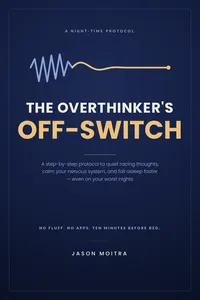
The Overthinker's Off-Switch
Jason Moitra
A step-by-step, no-fluff protocol for quieting a racing mind at night — built around the idea that there are only three kinds of 2am thoughts, and each one needs a different response. Includes a 10-minute wind-down routine, a plan for the moment you wake up already spiraling, and a 30-day path to a calmer nightly routine.
Who it's for
Anyone who regularly lies awake overthinking — replaying conversations, worrying about tomorrow, or unable to switch their brain off at night. It's a practical tool, not a replacement for therapy — and it says so honestly if what you're dealing with needs more support than a book can offer.
Get Out of Your Mind and Into Your Life
Steven C. Hayes, PhD
Written by the founder of Acceptance and Commitment Therapy (ACT), this book offers a genuinely different approach to overthinking: instead of trying to argue with or eliminate unwanted thoughts, it teaches you to change your relationship to them entirely, so they lose their grip regardless of whether they go away.
Who it's for
Readers who've tried to logically argue their way out of overthinking without success, and want to try the ACT approach of changing their relationship to thoughts instead.
Overcoming Unwanted Intrusive Thoughts
Sally M. Winston, PsyD & Martin N. Seif, PhD
For the specific, often distressing experience of intrusive, unwanted thoughts that loop uninvited, this book by two anxiety specialists offers real clarity and relief — explaining why everyone has strange intrusive thoughts, and why trying to push them away is exactly what keeps them coming back.
Who it's for
Readers dealing specifically with distressing, unwanted intrusive thoughts (not just general worry), who want to understand why the harder they try to stop them, the more they persist.
The Worry Trick
David Carbonell, PhD
Written by a psychologist who specializes in anxiety, this book explains worry as a trick your brain plays on itself — convincing you that more worrying equals more safety, when it actually just prolongs distress. It's especially good at explaining why trying to reason your way out of worry often backfires, and what to do instead.
Who it's for
Readers who intellectually know their worry is excessive but can't seem to reason their way out of it, and want to understand why logic alone doesn't work.
Declutter Your Mind
S.J. Scott & Barrie Davenport
This book treats mental clutter the same way productivity books treat physical clutter — as something you can systematically identify and clear out. It combines CBT-style techniques with mindfulness and habit-building, giving readers a genuinely varied toolkit rather than a single-technique approach to quieting a busy mind.
Who it's for
Readers who like the idea of "decluttering" as a framework, and want a varied toolkit spanning CBT, mindfulness, and habit change rather than one single method.
Stop Overthinking
Nick Trenton
A short, focused, no-filler book that goes straight at the mechanics of chronic overthinking — why your brain loops, and specific techniques to interrupt it. If you want something you can read in a weekend and start applying immediately, this is one of the more approachable, action-oriented options in this category.
Who it's for
Readers who want a short, practical, jargon-light introduction to overthinking specifically, without a long theoretical build-up.
The Anxiety and Worry Workbook
David A. Clark & Aaron T. Beck
Co-written by the founder of cognitive therapy himself, this workbook applies the core CBT model specifically to anxiety and chronic worry, with the exercises and rigor of a clinical program. If Feeling Great or Mind Over Mood felt broad, this is the more anxiety-specific companion, built on the same foundational research.
Who it's for
Readers whose primary struggle is anxiety and worry specifically (rather than depression), who want a CBT workbook built specifically around that presentation.